
Securing Your Law Firm logoSecuring Your Law Firm

External security monitoring for law firms

See what's exposed. Get alerts when it matters.

We find all the systems associated with your firm online. Then we watch them–looking for new vulnerabilities, changes to access controls, and exposure that needs attention. When something matters, we tell you. When you're ready to fix it, you can handle it with your IT provider or bring it directly to us.

The security picture changes in public too

Know what is exposed. Know when it changes.

Discover

Identify observable Internet-facing assets, technologies, certificates, DNS signals, and other public security indicators.

Monitor

Track meaningful changes to the firm’s external environment, including new exposure and shifts in configuration or trust signals.

Correlate

Match observed technologies and infrastructure with current vulnerability intelligence and newly disclosed issues.

Analyze

Review version ranges, authentication conditions, attack prerequisites, and available evidence to assess relevance.

Prioritize

Focus attention on what appears to deserve investigation first, instead of producing a long unsupported CVE list.

External asset discovery

Know what is visible from the Internet.

Security starts with knowing what is exposed.

We identify the public-facing assets, technologies, and trust signals associated with the firm so the next question is no longer, “What is out there?”

  • Domains and subdomains
  • Public-facing applications
  • Exposed services
  • Website technologies and components
  • TLS certificates
  • Email infrastructure
  • DNS configuration
  • Externally observable cloud or third-party services

That inventory becomes the baseline for ongoing monitoring and for deciding whether new findings appear relevant to the firm.

What it answers

What is exposed today?

  • External asset inventory and website technology discovery
  • Observable email and DNS infrastructure
  • Current public exposure baseline for the firm

External exposure

Your external attack surface is bigger than your website.

A law firm’s external attack surface often includes domains, subdomains, Internet-facing services, email infrastructure, certificates, cloud endpoints, and third-party technologies.

External asset discovery tells you what is visible. Continuous Security Verification adds monitoring and review so you can see when that picture changes and whether a new finding appears relevant.

This is often described as External Attack Surface Management, but the practical question is simpler: what changed, and does it matter to us?

  • Newly identified external assets
  • Technology changes
  • Certificate changes
  • Exposed services
  • Security configuration changes
  • Lookalike domains
  • Email-security changes
  • Newly disclosed vulnerabilities relevant to observed technology

Vulnerability intelligence

A public CVE is not the same as a firm issue.

Public vulnerability databases can tell you that a CVE exists.

The harder question is whether the affected technology appears to be present in your public environment and whether the evidence supports that the issue may apply.

  • Observe: What technology can we identify?
  • Correlate: What current vulnerabilities affect that technology?
  • Analyze: Do version information and attack conditions appear relevant?
  • Prioritize: What deserves investigation first?

Applicability analysis

Not every CVE is your vulnerability.

Seeing a vulnerability in a database does not prove that every observed installation is exploitable.

We review the evidence for the observed asset: affected versions, authentication requirements, attack conditions, and other prerequisites. That uncertainty is useful context, not a reason to hide the risk.

Confirmed
Likely affected
Conditional
Needs validation

Same-day vulnerability intelligence

Same-day vulnerability intelligence in practice.

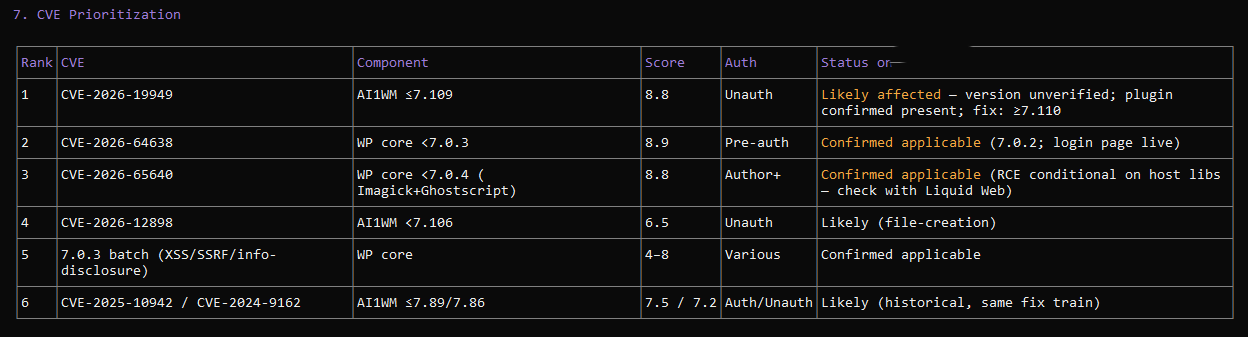
On August 25, 2026, our system correlated an observed WordPress component with CVE-2026-19949 on the day the vulnerability was publicly disclosed.

The affected component was observable, but its exact installed version could not be conclusively verified externally.

Instead of presenting an assumption as fact, the system classified the finding as “Likely affected” and elevated it for review.

That is evidence-backed vulnerability prioritization.

Read our CVE-2026-19949 analysis
Securing Your Law Firm vulnerability prioritization showing CVE-2026-19949 classified as likely affected

Purpose-built analysis

Security analysis backed by locally operated AI.

Our platform combines scanner evidence, current vulnerability intelligence, attack conditions, and remediation context with a locally operated AI-assisted review layer.

The objective is not more alerts. It is a clearer answer about what appears relevant and what deserves attention first.

What each program includes

Included serviceExternal Exposure MonitoringInternal Security VerificationComplete Security Verification
Minimum commitment6 months, then monthly6 months, then monthly6 months, then monthly
Free Zero-Access Exposure Review™
Monitoring of public exposure–
Lookalike domain alerts–
External security checks–
Microsoft 365 security settings–
Microsoft security-tool configuration–
Internal security checks–
Quarterly phishing and wire-fraud tests–
Annual penetration test––
Annual tabletop exercise––
Named security advisor––Optional
Insurance and client questionnaire support–

Pricing

Continuous Security Verification pricing

External Exposure Monitoring

External Exposure Monitoring

$249/month

6-month minimum, then month-to-month

Monitor what the public internet can see about your firm

  • Regular checks for fake-email risk, lookalike domains, and exposed websites
  • External checks for newly exposed or vulnerable services
  • Alerts when important public certificates, domains, or web settings change
  • Checks for known leaks involving firm domains and key personnel

Internal Security Verification

Internal Security Verification

$1,495/month

6-month minimum, then month-to-month

Keep your Microsoft 365 sign-in, email, and sharing settings secure

  • Ongoing checks of sign-in protection, email impersonation settings, forwarding rules, file sharing, administrator access, and activity logs
  • Microsoft security setting reviews and improvements
  • Internal checks for known security weaknesses
  • Quarterly tests using realistic phishing and wire-fraud scenarios

Complete Security Verification

Complete Security Verification

$4,495/month

6-month minimum, then month-to-month

Public monitoring plus Microsoft 365 security support

  • Everything in External Continuous and Internal Continuous
  • Combined public and internal security checks
  • A yearly security test scoped to your firm
  • A yearly exercise for wire fraud, ransomware, or client-data incidents

Standalone Phishing Testing Available: Internal and Complete continuous programs include quarterly phishing simulations as part of ongoing verification. If your firm needs standalone phishing testing or insurance documentation without a monthly monitoring retainer, see our Managed Phishing Testing & Staff Training (from $395).

Your firm's technology changes. So do the risks associated with it.

A new website, a provider change, or a newly disclosed security issue can create a new question–even when daily operations look normal. An initial review provides a starting point. Ongoing monitoring checks for meaningful changes within the agreed scope.

Monitoring tells you what needs attention. Fixing it is a separate decision.

When we find something, we explain what it is and why it matters. Fixes are quoted separately so you're never surprised by costs. Already have an IT provider? We coordinate with them. Don't have one? We handle the work directly.

Frequently asked questions

Continuous security questions for law-firm leaders

We identify what is publicly visible about your firm, monitor for meaningful changes, and compare that exposure with current vulnerability intelligence. The goal is not a long raw list of CVEs. It is a short list of items that appear relevant and deserve review.

No. A public clue is not the same as confirmed compromise. We look at the observed technology, affected versions, and available evidence to decide whether something appears relevant, likely affected, conditional, or needs validation.

A scan tells you what may be present at one moment. This adds ongoing observation, technical correlation, applicability analysis, and prioritization so you can focus on the items that deserve attention first.

Not for the external monitoring portion. The public-facing view is designed to assess what is visible from the Internet. Internal review can be added separately when the engagement scope includes it.

A firm’s public exposure changes when new domains appear, certificates change, technologies shift, or public vulnerabilities are disclosed. That can change risk even when day-to-day operations look stable.

We review the observed technology, affected version ranges, authentication conditions, exploit prerequisites, and uncertainty. The result is a confidence-aware finding grounded in evidence, not a generic assumption.

No obligation

Free Zero-Access Exposure Review™

2 minutes. No internal access. No passwords.

The free review is the fastest way to see what is visible today, then decide whether continuous security monitoring makes sense for your firm.