
CVE-2026-19949: What Law Firms Need to Know
CVE-2026-19949 was disclosed Aug. 25. See how continuous vulnerability scanning can help law firms identify newly disclosed website exposure before attackers do.
By Securing Your Law Firm
Start the free Zero-Access Exposure Review™ | See Continuous Security Verification
A WordPress vulnerability was publicly reported on August 25, 2026.
The important operational question is whether an affected component is present on a firm's Internet-facing site and whether its version can be verified.
Newly disclosed exposure can appear between scheduled reviews. That makes current asset visibility and authorized verification more useful than treating a public CVE as proof that a particular firm is affected.
For most law firms, that matters because their public-facing technology stack is often spread across several vendors: a website platform, a hosting company, a marketing provider, and an IT partner. Risk can shift without the firm changing anything at all.
What is CVE-2026-19949?
CVE-2026-19949 affects the All-in-One WP Migration and Backup plugin for WordPress through version 7.109.
The issue was publicly disclosed in August 2026 with a CVSS score of 8.8. The public advisory describes a second-order SQL injection condition in the plugin's archive restoration functionality. Under the documented attack chain, an attacker may be able to extract sensitive information and potentially escalate toward remote code execution.
Version 7.110 includes the fix. The official WordPress plugin page lists the update and the responsible disclosure tied to it.
The scope is significant. All-in-One WP Migration has more than five million active installations. That is not a niche issue.
There is also an important distinction between a severe vulnerability and one that is immediately exploitable. The disclosed attack path depends on conditions tied to archive restoration. That nuance is exactly why vulnerability management needs context, not just a CVE number.
Why this matters to law firms
A law firm website is rarely an isolated system. It is part of the firm's public-facing security posture, whether the site is managed in-house, by a marketing team, or by a vendor.
That creates a blind spot. The site may be considered “handled” by someone else, but the firm still owns the risk. When a plugin is vulnerable, the exposure is not limited to a browser. It becomes part of the firm's external attack surface.
This is especially relevant for small and mid-sized firms. They often have enough public infrastructure to attract attention, but not enough internal expertise to track every software change in real time.
The result is familiar: a new public disclosure appears, the issue is real, and the firm is still waiting for the next scheduled assessment or vendor update before it knows whether it is affected.
Same-day vulnerability intelligence
An external assessment can correlate observed technologies with current vulnerability intelligence. The goal is not to repeat a public vulnerability database entry. It is to answer the questions that matter to the organization being assessed:
- Is the affected software present?
- Does the detected version fall within the vulnerable range?
- Does exploitation require authentication?
- How severe is the issue?
- How confident is the match for this target?
- What version resolves the problem?
If a component can be identified but its exact version cannot be verified externally, the finding should remain qualified rather than presented as a confirmed vulnerability.
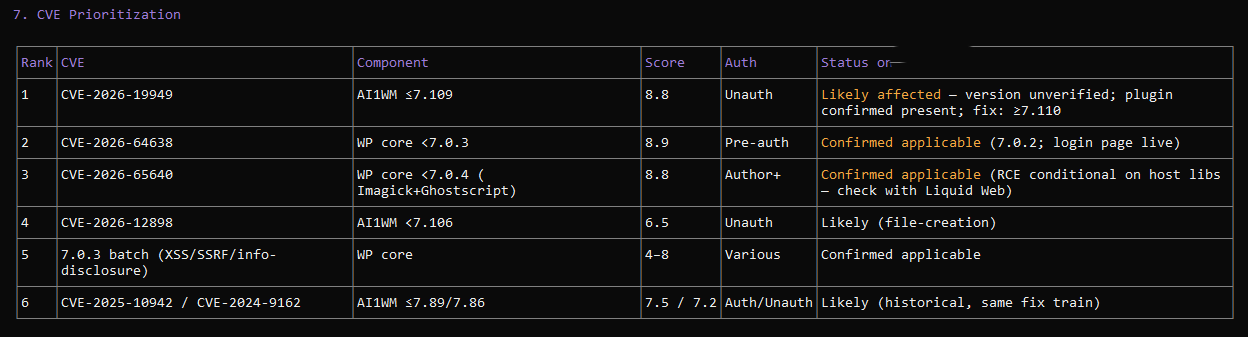
That distinction matters. Legal teams need actionable information, not inflated certainty.
Finding CVEs is easy. Finding the ones that matter is harder.
There are tens of thousands of known software vulnerabilities. A long vulnerability report is not necessarily a useful one.
Most firms do not need a raw list of every issue on the public Internet. They need a practical answer to one question:
What should we fix first?
That is the challenge our scanning platform was designed to address.
Instead of treating each CVE as equally important, the platform combines information such as:
- detected technology
- vulnerable version ranges
- CVSS severity
- authentication requirements
- known vulnerability characteristics
- applicability to the observed system
- remediation guidance
The goal is not to generate the biggest report possible. It is to identify the exposures that deserve attention.
Why timing matters
A vulnerability disclosure and a firm's next security assessment do not always happen on the same day.
A law firm could introduce a vulnerable plugin, service, or application the day after a review and operate with it for months before the next evaluation.
The same problem applies to firms that rely only on periodic audits. A snapshot tells you what exposure looked like at one moment in time. It does not tell you what changed afterward.
This is why continuous exposure awareness matters.
A firm's posture can change without the firm changing anything at all. The software remains the same. The risk does not.
That is one reason law firm security programs need to think beyond static, scheduled review windows.
Vulnerability prioritization is more than a CVSS score
CVE-2026-19949 also shows why a severity number alone is not enough.
The published CVSS score is 8.8. That deserves attention. But the actual attack path matters. A vulnerability that requires a specific sequence of actions may not be as operationally urgent as a remotely exploitable issue with no authentication and active exploitation in the wild.
Good vulnerability management requires both detection and context.
The right question is not only, “How severe is the CVE?” It is also, “Does this appear relevant to my environment, and what do I do first?”
What should firms using the plugin do?
Organizations running All-in-One WP Migration should verify the installed version and update affected installations to version 7.110 or later.
There is also a broader lesson here. How would your firm know a new disclosure affects an Internet-facing component? And how quickly would you know?
If the answer depends on someone seeing an alert, forwarding an email, or waiting for the next annual review, there is a monitoring gap. That gap is what we are trying to close.
A better model for law firm external security
At Securing Your Law Firm, we are building vulnerability scanning around a simple idea: a law firm should be able to understand its external exposure without needing a full-time security operations center to interpret the results.
That means identifying Internet-facing technologies. It means correlating them with current intelligence. It means separating theoretical vulnerabilities from issues that appear relevant to the actual environment. And it means prioritizing the exposures that deserve investigation.
The real objective is not another 400-page report. It is a simpler answer:
What on my Internet-facing infrastructure should I be worried about right now?
CVE-2026-19949 is a useful example. A public disclosure can identify a technology to verify, but it cannot establish that a particular firm's site is affected without evidence from that environment.
That is the difference between a static assessment and a practical security program.
Find out what your firm is exposing
Your law firm's website is only one part of its public attack surface. Internet-facing applications, forgotten subdomains, cloud services, remote-access systems, email infrastructure, and third-party technologies all create exposure.
Securing Your Law Firm helps firms identify and prioritize public exposure for authorized follow-up.
Visit SecuringYourLawFirm.com to learn more about external security assessments and vulnerability scanning.