
Independent law-firm cybersecurity
How exposed is your law firm?
We help small and midsize law firms identify security gaps, implement practical improvements, and prepare staff to recognize suspicious requests—with clear pricing and documented results.
We deliver the agreed security work directly and coordinate with your existing IT provider when needed.
Illustrative sample–not an assessment.
Public onlyPublic exposure signal
Example finding: a forgotten public service still visible online.
A stale login portal or outdated public-facing service may remain reachable long after ownership becomes unclear. That does not prove a compromise, but it does explain why a public review matters.
An older login portal and stale email record appear to be publicly reachable.
Confirm owner, verify whether the service is still active, and decide if a Baseline review is warranted.
Managed Phishing Testing & Staff Awareness
We set up realistic phishing simulations, deliver short follow-up training, and provide dated reports for your firm and cyber insurer—from $395 for up to 10 staff.
Most law firms do not know what attackers can already see.
The first question is not whether your firm has a good IT provider. It is whether your public exposure and core controls match the risk you actually carry.
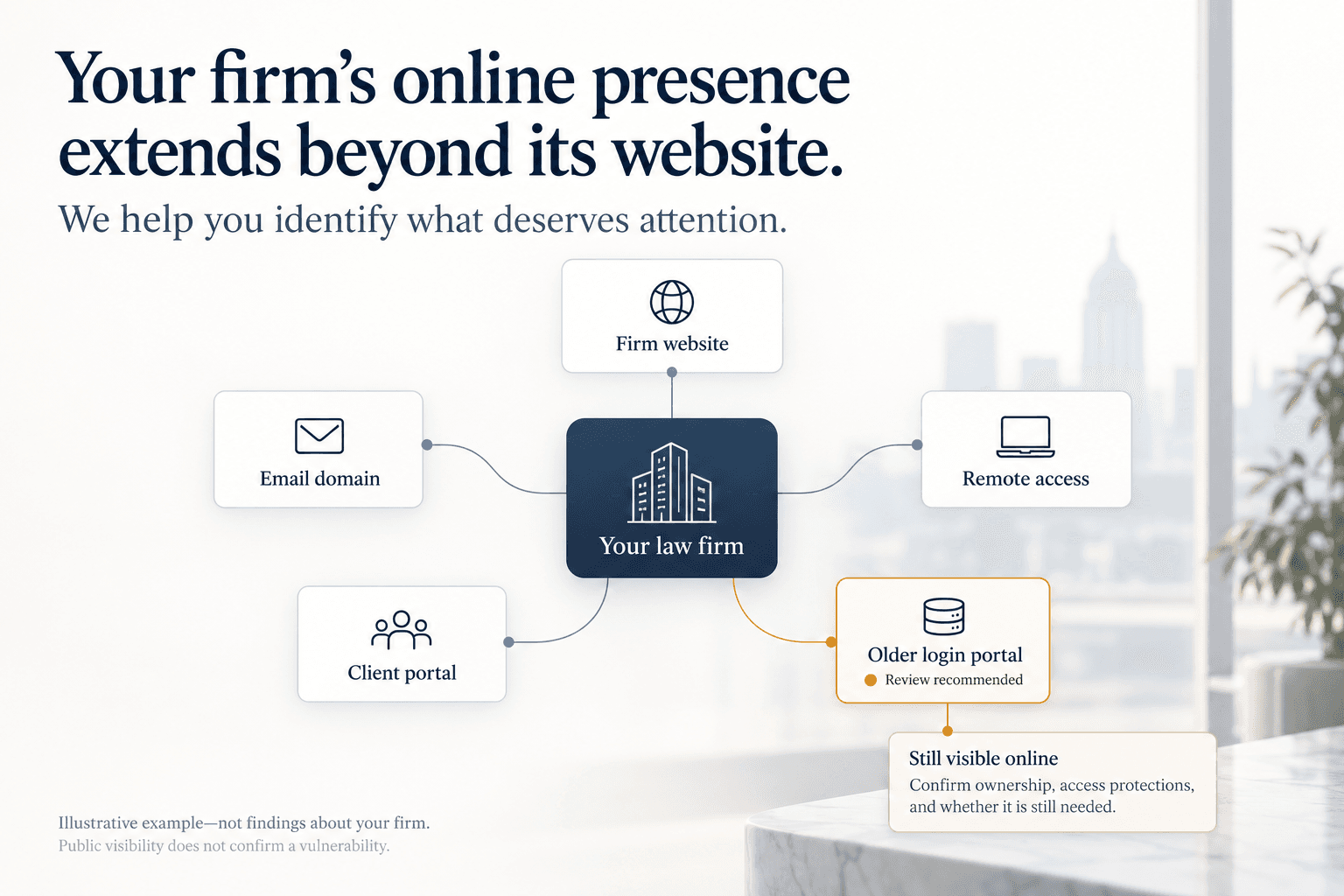
Illustrative example—not findings about your firm. Public visibility does not confirm a vulnerability.
View full-size illustrationPublic exposure and forgotten assets
Observation
Old domains, portals, and public services often remain online long after ownership, maintenance, or security responsibility becomes unclear.
Why it matters
When no one is clearly accountable, assets can age into exploitable public exposure without anyone noticing.
What we do
Identify what is publicly visible, who is responsible, and what should be fixed or retired first.
Email and domain impersonation
Observation
Spoofed messages and lookalike domains can make a fraudster appear to be a partner, firm, or vendor.
Why it matters
Law firms are frequent targets because a convincing email can trigger a payment, a trust decision, or a credential reset.
What we do
Review email authentication, domain integrity, and impersonation exposure with clear next steps.
Identity, Microsoft 365, and device risk
Observation
Strong access controls, logging, patching, and MFA are often unevenly enforced even in otherwise reputable firms.
Why it matters
Weak identity settings and missing evidence make a small gap look much larger to insurers, clients, and leadership.
What we do
Verify the controls that matter most, then prioritize the changes with the strongest business impact.
Primary security progression
A clear path to stronger law firm security.
From public exposure to a practical decision: see what is visible, verify the controls that matter, address the gaps, and maintain the picture over time.
START
Free Zero-Access Exposure Review™
See what is publicly observable before deciding whether a deeper review is warranted.
Start with the reviewVERIFY
Law Firm Security Baseline
Verify the essential controls protecting client information, email, identities, devices, and Microsoft 365.
See the BaselineADDRESS
Priority Security Improvements
Fix the gaps that actually apply to your firm, with scope confirmed before work begins.
View remediation optionsMAINTAIN
Continuous Security Verification
Monitor meaningful public exposure changes and keep the picture current after the baseline.
Review monitoringSecondary practice area
AI Governance for firms adopting Microsoft Copilot or other AI tools.
We also provide law firm-specific AI governance and readiness reviews for firms adopting Microsoft Copilot or other AI tools. This complements the firm’s broader security baseline and public-exposure work rather than replacing it.
Free starting point
Start with the free Zero-Access Exposure Review™
2 minutes. No internal access. No passwords.
It gives you a plain-English view of public exposure before you decide whether a deeper baseline or targeted remediation is warranted.