
Is Your Law Firm’s Website Serving Indonesian Gambling Ads?
A recent assessment found a subdomain serving unrelated gambling content. Learn why law firms should look beyond their homepage–and where to start.
Is Your Law Firm’s Website Serving Indonesian Gambling Ads?
Your homepage looks professional. But what is the rest of your domain serving?
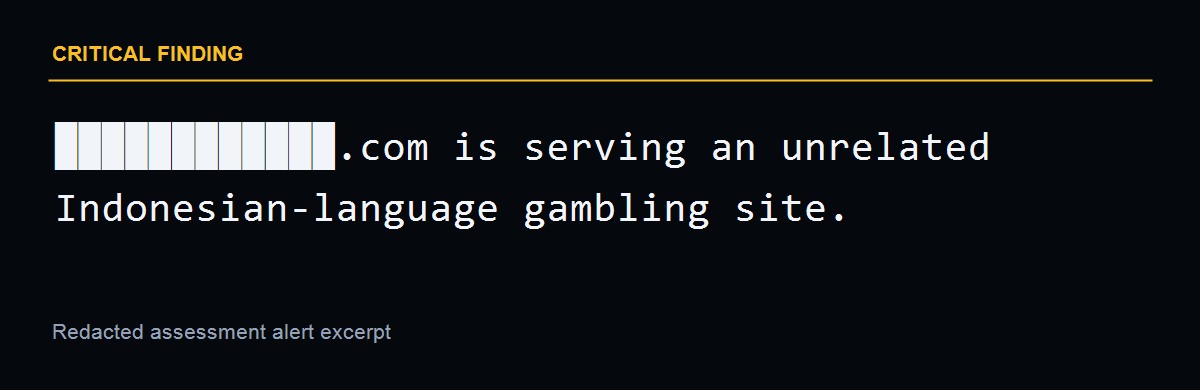
During a recent assessment, we found a subdomain serving an unrelated Indonesian-language gambling site.
The address was associated with the organization, but the content had nothing to do with its business.
For a law firm, imagine a prospective client following an old link with your firm's name in it–and finding online slots instead of legal services.
Your website is more than its homepage
A subdomain is an address under your main web address, such as `events.example.com` or `portal.example.com`. Firms often use them for events, client services, or tools run by outside vendors.
When a firm changes website providers or retires a service, the old address may not disappear. Looking at the homepage does not show what every address connected to the firm is displaying.
What this finding means–and what it does not
Unexpected gambling content is a warning sign. It needs investigation, but it does not by itself explain how the content appeared.
Possible explanations include a changed website, a hosting mistake, or an old address that points to a service the firm no longer controls.
A recognized risk is subdomain takeover. This can happen when an old internet record still points to a retired service that somebody else can claim. Microsoft explains the risk. It is one possible explanation here, not a confirmed cause.
The alert called for follow-up: check the internet records, hosting arrangements, and page details. It does not establish whether any client information was accessed. The language on the page also does not show where an attacker may be located.
Why a firm manager should care
- Client trust: A familiar web address can make an unexpected page appear to belong to your firm.
- Search results: Google treats hacked pages, injected content, and malicious redirects as abuse. These issues can affect search visibility, although this finding does not establish that a penalty occurred. Google's spam policies
- Unclear ownership: Your website agency, IT provider, and former vendors may each manage different pieces. A forgotten address can fall between them.
The question to ask your IT provider
"Can we account for our publicly reachable subdomains, who controls them, and what they currently display?"
If the answer is no, ask for an inventory and a named owner for each address. If unexpected content appears, ask the provider to:
- save the page details and related records before making changes;
- check who controls the hosting and internet records; and
- remove or secure the exposure once the cause is understood.
Removing the visible page alone may not fix the underlying problem.
Start with what the public can see
Securing Your Law Firm helps small and midsize firms identify public exposure that deserves attention, including issues beyond the main website.
Start with our Free Zero-Access Exposure Review™. It reviews publicly available information without needing access to your internal systems. The result gives you a practical starting point for a conversation with your IT provider or MSP.
Your firm's name should lead to content you recognize.
Related reading
- What Is External Attack Surface Management (EASM) for a Law Firm?
- Your Law Firm Has More Internet-Facing Doors Than You Think
- Law Firm WordPress Security: The Elementor Pro Warning
- We Found a Law Firm's Remote Desktop Online – Will a Hacker Be Next?
- Cybersecurity for Small & Midsize Law Firms
This article is intended to support governance and website-maintenance decisions. It is not legal advice.