
Law Firm Cyberattacks and Data Breaches in 2026: A Running List
Track law firm cyberattacks and data breaches reported in 2026, including Clifford Chance, WilmerHale and Baker McKenzie, with practical lessons for small firms.
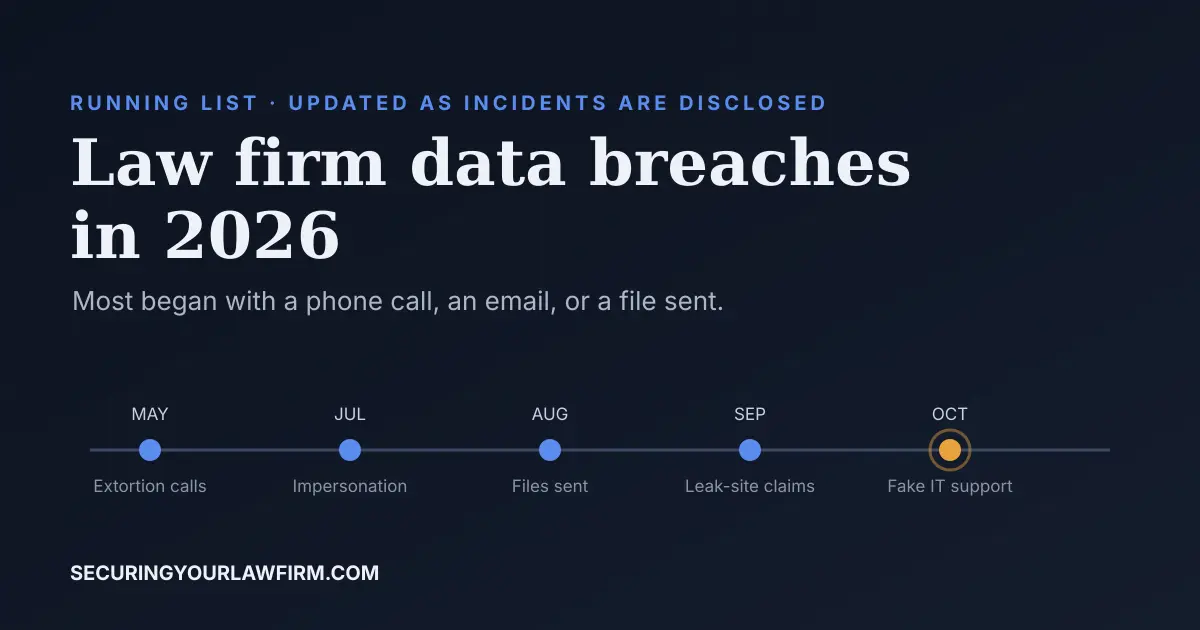
This running list of law firm cyberattacks and data breaches covers 21 firms as of November 18, 2026, from WilmerHale and Baker McKenzie to firms with a few dozen lawyers. It includes firm disclosures, published reporting, and separately identified, unverified extortion claims.
The latest addition is Clifford Chance, following November reporting about a cyberattack involving client data. In many of the incidents where the method is known, attackers persuaded someone to grant access or send documents.
If you read the legal press this year, you could be forgiven for thinking every major law firm in the country has been breached. That's an exaggeration, but not by as much as it should be.
Weil Gotshal, WilmerHale, Goodwin Procter, Fox Rothschild, Quinn Emanuel, McDermott, Sheppard Mullin, Baker McKenzie and Troutman Pepper Locke all disclosed incidents or were publicly reported as victims in 2026. Four of Canada's largest firms followed in October. Smaller firms, some with a few dozen lawyers, have turned up on extortion leak sites alongside them.
The names are what make headlines. The more useful part is how these breaches happened, because the method in most of them is something any firm, of any size, can recognize and prepare for.
This page collects what has been publicly reported, groups the incidents by how they happened, and lays out what a small or midsize firm can do about each pattern. We update it as new incidents are disclosed.
Law firm cyberattacks and data breaches reported in 2026
The table below summarizes each incident using the firm's own filings where they exist, and published reporting where they don't. Where a detail is a claim by attackers or an unconfirmed report, we say so. Follow the links for our coverage or the underlying news report.
| Firm | When | What was reported | Coverage and sources |
|---|---|---|---|
| Weil Gotshal & Manges | May 2026 | Extortion after client documents were stolen; a reported payment of $18–20 million | The $46 million extortion campaign |
| WilmerHale | Incident May 8; notices from July 10 | An employee gave information to someone posing as a legitimate requester; names and Social Security numbers involved; a proposed class action followed | WilmerHale data breach |
| Goodwin Procter | 2026 | Reported extortion payment of around $10 million | The $46 million extortion campaign |
| Fox Rothschild | Late May 2026 | One attorney fell for a social engineering call; 57,554 people affected; class action expanded in August | Fox Rothschild class action |
| Mayer Brown, Farella Braun + Martel, Sandberg Phoenix | 2026 | Named on the same group's leak site; one firm reportedly offered $520,000 and was posted anyway | Leak site expands to smaller firms |
| Troutman Pepper Locke | August 7, 2026 | An employee sent documents to an unauthorized person after communications that looked legitimate | Baker McKenzie and Troutman Pepper Locke |
| Baker McKenzie | August 14 and 17, 2026 | Two users deceived; files containing personal information obtained | Baker McKenzie and Troutman Pepper Locke |
| Sheppard Mullin | August 31, 2026 | One attorney deceived into disclosing documents; the firm reports no system compromise | Sheppard Mullin breach |
| Quinn Emanuel and McDermott | Reported September 3, 2026 | Separate social engineering incidents, each involving one user and a limited set of documents | Quinn Emanuel and McDermott breaches |
| Tarter Krinsky & Drogin | Servers accessed July–September 2025; HHS listing September 2026 | Network intrusion affecting 196,645 people connected to healthcare clients | The client records at risk |
| Mestechkin Law Group, The Zhou Law Group, Bauman Law Group | September 2026 | Extortion claims by three different groups; not independently verified | Booba, Eclipse and Qilin claims |
| McCarthy Tétrault, Davies, Bennett Jones, BLG | October 2026 | Attackers posing as IT support talked staff into giving access; client-related files affected at some firms | Canadian law firm breaches |
| Clifford Chance | Reported November 17, 2026; incident date not established | Client-data exposure reported by The Lawyer and relayed by City AM; attack method and scope not established; the firm declined to comment | City AM report |
Last reviewed November 18, 2026. Dates distinguish incident dates from reporting or disclosure dates where known.
Clifford Chance cyberattack: what was reported in November
On November 17, The Lawyer reported that Clifford Chance had suffered a cyberattack. City AM's follow-up coverage, citing The Lawyer, said client data had been exposed. Clifford Chance declined to comment to City AM and Legal IT Insider.
The reporting reviewed for this update does not establish the initial access method, the amount of information affected, or who was responsible. City AM explicitly separates the Clifford Chance incident from the Optimizely attack affecting Freshfields. We have therefore kept Clifford Chance outside the social engineering examples below.
Across the incidents where the method is known, a recurring weakness is the moment someone trusts an unexpected request. The following patterns explain how a call, an email, or a document transfer can expose client information.
Pattern one: the call from "IT support"
The largest cluster of 2026 incidents traces back to one group. The FBI calls it Silent Ransom Group; researchers also track it as Luna Moth and Chatty Spider. Reporting has attributed roughly $46 million in payments and demands involving major firms to its campaign.
The method is simple and doesn't involve ransomware at all. Someone calls an employee, introduces themselves as the firm's IT help desk, and walks the person through installing a remote-access tool. Once they're in, they copy documents and threaten to publish them. In some recent cases, the FBI has warned, the "technician" has shown up at the office in person.
Speed is part of the problem. CrowdStrike's 2026 legal-sector report describes one intrusion by this group where data theft began four minutes after the attacker got access. It also found that law firms made up nearly 90% of the group's victims during the reporting period. Our coverage of how law firm cyberattacks can lead to rapid data theft explains the research and the limits of that four-minute example.
The Canadian breaches in October followed the same script. According to The Globe and Mail, attackers called staff at McCarthy Tétrault, Davies, Bennett Jones and Borden Ladner Gervais about urgent updates or password problems, sometimes through Microsoft Teams. BLG said the attackers reached part of its Microsoft cloud environment.
What to do about it: give every employee one rule they can follow under pressure. Nobody installs software or approves a sign-in because a caller asked. They hang up and call IT back on a number the firm already has. Our IT support verification checklist includes a callback script you can print and use this week.
Pattern two: a convincing request, a file sent
The second group of incidents didn't involve anyone breaking into anything. A person with legitimate access was persuaded to hand information over.
WilmerHale's notice to New Hampshire regulators describes an employee providing information to someone who had misrepresented who they were. Sheppard Mullin told California's Attorney General that one attorney was deceived into disclosing documents, and that its systems were never compromised. Troutman Pepper Locke described an employee who responded to communications that seemed legitimate and sent documents to an unauthorized person. Baker McKenzie said two users were deceived on separate days in August.
Quinn Emanuel and McDermott each described their incidents the same way: one user, a limited set of documents.
This is uncomfortable reading for anyone who has spent money on firewalls and endpoint protection. None of those tools stops an associate from attaching a file to a reply. Multi-factor authentication doesn't help when the employee is the one sending the documents.
What to do about it: treat any request to send client documents, identification records or financial details somewhere new as something to verify before acting. That means confirming through a known phone number or an existing client portal, not by replying to the message that asked. Our wire instruction verification checklist was written for payment changes, but the same callback habit works for document requests.
Pattern three: the old-fashioned network intrusion
Not every breach this year was social engineering. Tarter Krinsky & Drogin, a New York firm, reported that an unauthorized party accessed certain servers at various times between July and September 2025. The firm appears on the federal health breach portal as a HIPAA business associate, with 196,645 people affected.
That number is the real lesson. Those people weren't the firm's clients. They were connected to the firm's healthcare clients, and their records came into the firm's systems through ordinary legal work.
Most small firms underestimate how much personal information they hold. A single employment matter, insurance dispute or healthcare engagement can bring in records for thousands of people who have never heard of the firm.
What to do about it: know where sensitive records live, who can reach them, and whether old matter files are still sitting on a server or in a shared drive nobody reviews. Our guide to the client records at risk in a law firm data breach walks through that inventory.
An intrusion that runs for months is also a monitoring question. Someone should notice unfamiliar remote logins, unknown devices, or failed backups while it is happening, not months later. Network monitoring for law firms watches for those warning signs and alerts both your firm and your IT provider. For a plain-English list of what to watch, see what a law firm should monitor on its network.
Pattern four: it isn't only BigLaw anymore
It's tempting for a ten-lawyer firm to read this list and assume it's a large-firm problem. The evidence this year says otherwise.
The extortion group's leak site now lists firms with revenue as low as about $21 million, according to The Insurer, alongside firms earning more than $2 billion. In September, three different groups claimed attacks on smaller U.S. practices, including a California family law firm. CrowdStrike counted 455 legal entities named on data leak sites between September 2025 and August 2026, a 39% increase over the prior year.
Smaller firms aren't targeted because attackers confuse them with BigLaw. They're targeted because they hold the same kind of sensitive information with fewer people and processes standing between a convincing phone call and the files.
What the lawsuits tell you
A breach doesn't end when the forensic investigators leave.
Fox Rothschild's incident involved a single device. Within two weeks a proposed class action was filed, and in August a California resident asked to add a claim under the California Consumer Privacy Act. WilmerHale faces its own proposed class action in federal court in Washington, D.C. Both cases are contested, and filing a lawsuit isn't a finding of liability. But the cost of defending one is real regardless of the outcome.
There's also the professional responsibility side. ABA Model Rule 1.6(c) asks lawyers to make reasonable efforts to prevent unauthorized disclosure of client information. Comment 8 to Rule 1.1 ties competence to understanding the risks of relevant technology. ABA Formal Opinion 483 addresses what lawyers owe clients after a data breach, including monitoring for breaches and notifying clients in many situations. How those obligations apply depends on the facts and your jurisdiction's rules, but the direction is clear enough: a documented, reasonable security program matters before an incident, not just after.
Why training belongs at the center of the response
Look back at the four patterns. Technical controls matter for every one of them, and we'd never suggest a firm skip MFA, email authentication or proper access controls. But in most of the 2026 incidents, the decisive moment was a person deciding whether to trust a request.
That's the gap security awareness training is meant to close. The trouble is that the annual compliance video most firms rely on doesn't build the habit these attacks exploit. Watching a slideshow about phishing in January doesn't prepare a legal assistant for a polished call from "the help desk" in August.
What works better is regular, realistic practice. That's how we've built the training and phishing simulation programs we run for law firms.
The starting point is weekly decision challenges. Each week, every employee gets a short scenario drawn from legal work, such as a changed wire instruction, a fake e-filing notice or an unexpected sign-in prompt, and learns the safer response. Your office manager can see who completed it and how they scored. Plans start at $49 a month for up to 10 people. See how the challenges work in our cybersecurity training for law firms.
Our Managed Phishing & Awareness program adds the practice that most closely mirrors this year's breaches. We choose the scenarios, run the campaigns, follow up with staff and review the results with firm leadership each quarter. It includes:
- Simulations that act like real attackers. Monthly simulated phishing emails use the lures law firms actually receive. Some carry on a back-and-forth conversation when an employee replies, the way a real impersonator would. Voice-call simulations can rehearse the fake IT support call behind so many of this year's incidents, scoped and authorized with your firm first.
- Training at the moment it counts. When someone clicks a simulated link, a five-to-ten-minute lesson on exactly what they missed is assigned right away, while the example is still fresh.
- Your own threats, made safe. Real phishing emails your staff report can be turned into harmless simulations, so the next round of practice matches what your firm is actually seeing.
- A clear picture of risk. Each employee has a risk score and progress history, so you can see who needs more support instead of retraining everyone the same way.
- Records you can show an insurer or client. Completion certificates and campaign reports give you evidence when a carrier or client security questionnaire asks about training.
The managed program starts at $199 a month for up to 10 people and includes the weekly challenges. If you'd rather start with a single baseline test, a one-time phishing campaign starts at $395.
How to prepare for a law firm cyberattack
Start at your next partners' meeting. These five questions will show you where your firm stands:
- If someone called claiming to be from our IT provider, what would our receptionist do?
- Who in the firm can send client documents outside the firm, and is there any check when the destination is new?
- When did each of us last practice spotting a phishing email or a fraudulent request, rather than just hearing about one?
- Do we know which closed matters still have sensitive records sitting on our systems?
- If an employee realized they'd sent a file to the wrong person, do they know exactly who to tell, and would they feel comfortable telling them?
If more than one of those answers is "I'm not sure," that's a normal place to be, and a useful place to start.
If you need help verifying the safeguards your firm relies on, our Law Firm Security Baseline checks email, Microsoft 365, devices and backups. You get a prioritized list of what to fix first.
If you’re wondering what automated tools can learn before anyone contacts your firm, see what AI agents can find on law firm websites and in public records.
Where to go from here
The firms on this list had security teams, outside counsel and serious budgets. What caught them out was usually a single, convincing moment. You can't remove every one of those moments, but you can make sure your people have practiced handling them.
If you'd like to see what that looks like for your team, start with cybersecurity awareness training for law firms, or talk to us about a managed program sized for your firm. If you want to know what an attacker could learn about your firm from the outside first, request a Free Zero-Access Exposure Review™. It needs only your domain and work email.
And keep a law firm incident response plan on file, so that if something does slip through, nobody is guessing who to call.
Related reading
Sources
This article summarizes public reporting and firm disclosures through November 18, 2026, and does not constitute legal advice.